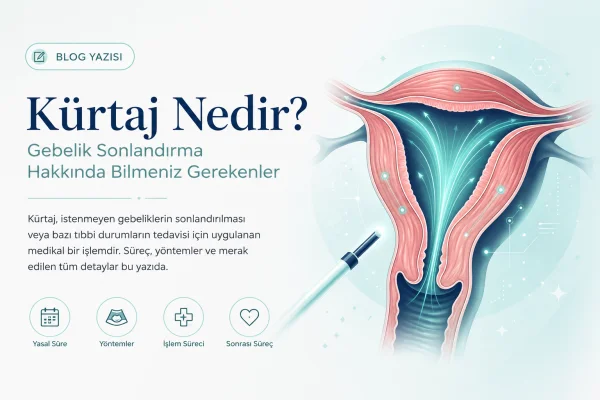


Abortion Clinic in Adana: How Is the Process Planned?
This article is for general information only. The suitability of a method can only be determined after a gynecologist's assessment.
People researching an abortion clinic in Adana usually want to know how the procedure is done, which checks are needed beforehand, how vacuum aspiration works, whether anesthesia is used and what happens afterwards. Not every procedure is the same: gestational week, ultrasound findings, general health and previous pregnancies all play a role. Op. Dr. Hüseyin Kılıç evaluates patients at his clinic in Ziyapaşa, Adana, by examination and ultrasound and informs them about the appropriate process.
What to Consider When Researching a Clinic
- gynecological examination before the procedure,
- ultrasound assessment of the gestational week,
- confirmation that the pregnancy is inside the uterus,
- review of the medical history,
- choice of a suitable method and, if needed, anesthesia or sedation,
- information and follow-up after the procedure.
What Is Abortion?
Abortion is the medical removal of pregnancy tissue from the uterus. It is not only used for unwanted pregnancies; uterine evacuation may also be necessary in some medical situations.
Examination and Ultrasound Beforehand
Ultrasound shows the gestational week, the location of the sac, whether the pregnancy is intrauterine, and the general appearance of the uterus and ovaries. An ectopic pregnancy is a different condition and is not treated with a standard abortion procedure.
Vacuum Aspiration
Through the cervix, the uterus is reached with suitable instruments and the pregnancy tissue is removed in a controlled way with a vacuum aspiration system. Suitability depends on the gestational week, ultrasound findings, uterine structure and health; it may not be suitable for every patient.
Is It Painful? Abortion Under Anesthesia
Pain depends on the method, anesthesia, gestational week and pain threshold, so it is not correct to promise that it is "completely painless". In suitable patients, local anesthesia, sedation or other pain-control methods may be used. If anesthesia is planned, preparation such as fasting may be required.
Duration
The procedure itself is usually short, but total time includes examination, ultrasound, preparation, anesthesia if needed, and follow-up.
After the Procedure
Light bleeding, spotting, mild pelvic pain and period-like cramps may occur. Seek medical evaluation for very heavy bleeding, increasing pain, high fever, foul-smelling discharge, fainting or marked dizziness. The first period timing varies. Ovulation can resume before the first period, so contraception should be discussed. In most women fertility is preserved after a procedure under appropriate conditions; rare complications include infection, bleeding, retained tissue, injury and intrauterine adhesions. Sexual intercourse should be paused for the period advised by the doctor, and recommended check-ups should not be missed.
Privacy
Health information, examination findings, pregnancy details and procedures should be handled within patient confidentiality. Personal questions are best discussed directly with the doctor.
What Matters When Choosing a Clinic?
Decisions should not be based only on duration or price. Specialist assessment, ultrasound, determination of the gestational week, method selection, anesthesia options, hygiene and medical standards, aftercare information and privacy should all be considered.
Frequently Asked Questions
Can abortion be done with anesthesia?
In suitable patients, local anesthesia or sedation may be used.
Can I become pregnant again afterwards?
Yes. Ovulation can resume before the first period.
In Adana
Patients from Seyhan, Çukurova, Yüreğir, Sarıçam and other Adana districts can contact the clinic of Op. Dr. Hüseyin Kılıç in Ziyapaşa, Adana, for an individual assessment.